 I hate answering the telephone. I will watch it ring and ring from the corner of my eye, paralyzed by fear and unable to look away. When it eventually stops, I feel both ashamed of myself and triumphant that I avoided the trauma of a human conversation. For me personally, the circumstances surrounding a phone call aren’t even that bad. The conversation will be in English, my first language, and the subject matter will be relatively predictable. It’s either a doctor’s office calling to remind me of an appointment or a university alumni center asking for donations, which both use routine scripts that don’t require extra attention. Even under ideal listening conditions, the phone blurs or omits various frequencies that make the caller’s voice difficult to understand – for example, making it difficult to distinguish words like “fight” from “sight.” In person, I could read lips or use visual input like gestures to help me figure out meaning. On the phone, my ears are on their own. (more…)
Adaptation and the importance of hybrids

How do species adapt to new conditions? For a couple hundred years, the answer has been that incremental change in parents trickles down to offspring over generations in a population, giving us the process of biological evolution. That is just as true as ever, but it appears to be a bit more complicated. Where once scientists saw life on Earth as a tree, united at the trunk of some primordial population and extending an increasing number of independent branches with the progression of time, it now appears to be more of a tangled shrub, with adaptations occasionally being shared across populations in a more lateral fashion.
Adaptive introgressive hybridization is a process by which beneficial traits can jump horizontally across population or species lines. Adaptive evolution may continue only as long as there is variation in a trait for selection to act upon, and the rate of evolution is proportional to the variation present. Therefore, when alien individuals from other populations are introduced to an evolving population, it may increase the amount of variation and thus the rate of adaptation in the recipient population. (more…)
Soooo mysterious: The hidden fungi of plants.
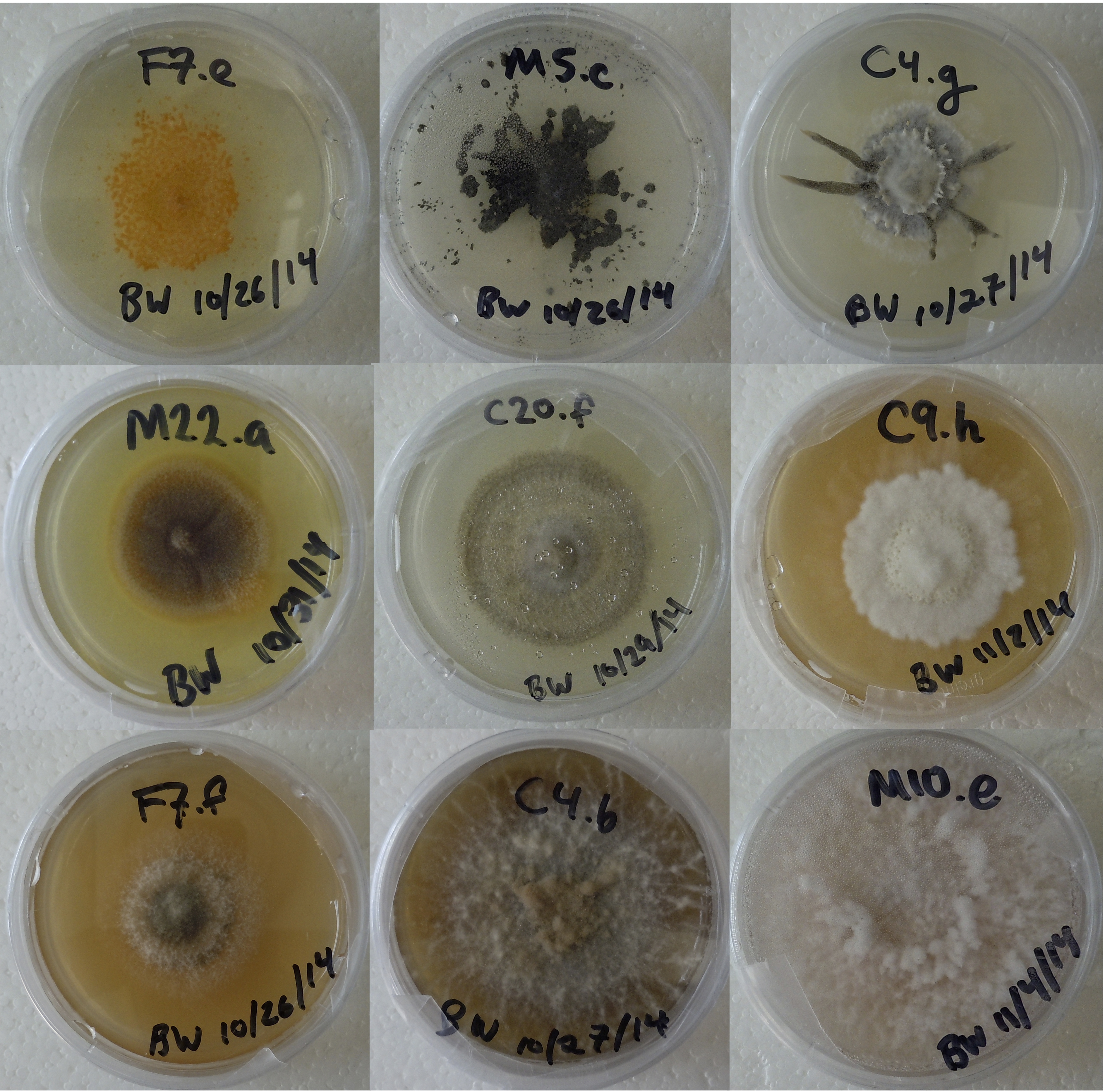
Have you ever picked a fallen leaf off the ground and wondered where it came from? Stared at the trees changing colors and losing their leaves above you, as those leaves ultimately find their way to the massive piles young kids like to jump into? Well, ever since I started delving into the strange and wonderful world of plants and the fungi that live on them, I haven’t been able to look at leaves the same way. My research focuses on tiny fungi that live inside of plant leaves. Known as ‘endophytes,’ these little critters form some of the most mysterious associations on the planet. Each plant leaf can be colonized by up to hundreds of different tiny fungi, which grow locally inside the plant tissues. Where do these fungal endophytes come from, I ask? If we can’t see or hear them, how do we determine their effects on the different plants they live on? This is a big dilemma of my research. By extracting DNA from these fungi and using specific stretches of the fungal genome as a target, I am able to collectively identify the fungal inhabitants of my research plants – no matter their size, abundance, or location within a single host.
One of my main research projects uses Switchgrass as a model system (aka an “example system”) for studying fungal colonizers. Switchgrass is an excellent plant to study for several reasons. Switchgrass is a tallgrass plant species that grows in most states east of the Rockies. It requires very little water or fertilizer in order to grow, yet it can still produce impressive yields of leaf and stem mass. Because of its robust characteristics and widespread distribution in the United States, Switchgrass is currently a top biofuel candidate being studied by the government. (more…)
What is science, really?

On May 17, 2010 in Geneva, a bronze statue of a child being vaccinated was unveiled to celebrate one of humanity’s great victories: the eradication of smallpox. In the words of the World Health Organization, 1980 was the year in which “the world and its peoples [had] won freedom from smallpox, a most devastating disease sweeping in epidemic form through many countries …, leaving death, blindness and disfigurement in its wake.” [1] Such a victory meant that no human born after 1980 would ever be a victim of this terrible virus, or carry the characteristic scars left by the smallpox vaccine. Indeed, 1977 saw in a Somali man the very last natural case of this disease.
What kind of tool allowed humans to deliberately target and extinguish an invisible threat that had afflicted more than half of humanity 50 years earlier? What is this power that enables our species to mold the world so permanently? If you came to this blog post out of your own volition, in the same way we, the writers, did, you must also be intrigued by these questions, and hopefully inspired by what you probably suspect the answer is: this incredibly powerful and stimulating human activity called science! (more…)
Launching Fall 2016!
A new and exciting science blog brought to you by graduate students in the the College of Arts & Sciences at Indiana University.
Watch for our debut here the first week classes, Fall 2016!
ScIU – Conversations in Science at Indiana University
