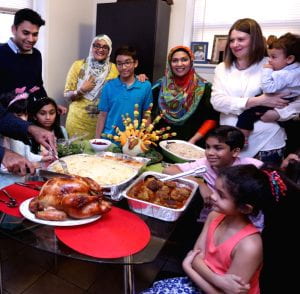
Islam in Zanzibar by Darby FitzSimmons
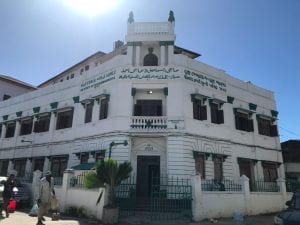
When most Americans think of Muslim countries, their minds immediately go to the Middle East: Saudi Arabia, Iran, Afghanistan – maybe they’ll think about Türkiye, or more rarely, North African countries like Tunisia. However, it’s rare that if you ask an American to name a country with a rich and vibrant Islamic history, they will mention a sub-Saharan African country. Yet, by the eighth century, Islam was well established through West Africa and along the Swahili Coast of East Africa.
Kurds and Religion, Then and Now by Claire Jacobson
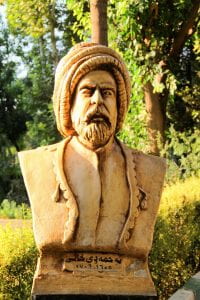
Depending on whom you ask, the meaning of “Kurdish religion” varies greatly. In Iran, Kurds constitute a religious as well as an ethnic minority, making up a large part of Iran’s Sunni Muslim population. In Türkiye, Kurds are mostly part of the Sunni majority, although there is a significant Kurdish Alevi minority as well. In Syria, a Sunni majority lives alongside significant minorities of Alawites and Yazidis. In Iraq there is a Sunni majority and a Shi’a minority as well as Yazidis and a number of other indigenous religious communities. Scattered communities of Jews and Christians can be found across the region as well, although most indigenous Christians belong to ethnically distinct Assyrian, Chaldean, and Armenian rites.
“Do Something Good For Yourself” by Havva Berfin Yalçın
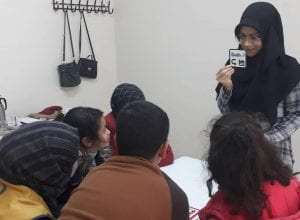
I have always been someone who likes to be social. I spent time with school, classes, and friends during the first year of my college life. Everything was great but there was something missing. This absence that I was feeling deep inside had become a problem which I couldn’t figure out because I didn’t know what it was.
Muslim Intellectual History: Survey, Map, and Timeline by Saulat Pervez

Muslim intellectual history is rich and complex. It started as a simple effort to continue to live according to the legacy of Prophet Muhammad (s) – Sunnah – in the aftermath of his death, became refined over time, and also branched into new directions even as it remained grounded in core revelatory concepts. Yet, too often, students of Islam in general and Islamic studies programs in particular learn the core disciplines of Qur’an, hadith (reports of prophetic words, actions, and habits), and fiqh (jurisprudence) along with secondary subjects such as mysticism, theology, and philosophy as discrete blocks of knowledge.
Rediscovering the Arab Agricultural Revolution [Part II] by Ann Campbell

We know that the westward expanse of Islam covered significant portions of southern Europe. From the eighth to the fourteenth century CE (until 1492, in fact), portions of the Iberian Peninsula, Sicily, and France were under Arab rule. This is evident in the decorative arts and architecture that remain there, but also in many foodways, which are often touted as iconic European foods, and agricultural technologies.
Rediscovering the Arab Agricultural Revolution [Part I] by Ann Campbell
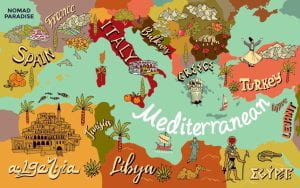
Popularized in American culture in the 1970s, the “Mediterranean diet” touted health benefits of “traditional” foods focusing on fish and vegetables with olive oil as the primary fat. The Mediterranean diet became such an icon that it was declared an “intangible cultural heritage” by UNESCO in 2013. But in the popular imagination this diet was largely built of influences of Greek, Italian, Spanish, and Southern French cuisine. Anyone who has seen a map, though, knows that a lot is missing. Where in this version of the Mediterranean diet were the foods of Turkey? Of North Africa? Of Syria?
Rapping in Germany When Your Roots are Turkish and Muslim – Aziza A.! and Matters of Representation…. by Derya Doğan

Imagine listening to hip-hop with lyrics in German but the melody starts and ends with a Turkish folk song, and Ney, the Muslim Sufi flute, playing in the middle… Or rapping in German as if speaking in Turkish…This is exactly what Aziza A. does! [1]
Born and raised in Berlin to Turkish immigrants [2], Aziza’s dream was to become an actress when she was a child. Instead, she became the first female Turkish-German rapper and one of the several other outstanding female rappers who challenged the male dominated German hip-hop scene. She stands out because of her “Turkish roots” and the way she bravely challenges gender stereotypes about Turkish culture and even Islam to some extent in her songs. Aziza touches on social struggles of the Turkish diaspora in Germany by incorporating themes such as immigration, religion, and modernity. Some of her songs make reference to Islamic elements while some other ones focus on diasporic problems specifically.
Hijab in Sports: Bilqis Abdul Qaadir Visits IU with Messages of Empowerment and Spirituality for Muslim Women by Narmeen Ijaz
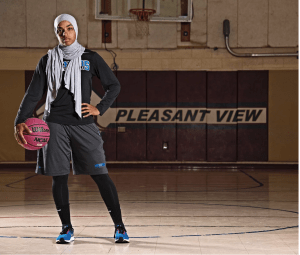
Hijab (Veil) is a term which has multiple images associated with it. For some it might bring to surface images of the ongoing protests in Iran by women to end the mandatory hijab, while for others, it might recall images of Muslim women in France fighting against the Hijab ban. Such duality of the meaning and interpretation of Hijab can be challenging to understand without indulging into the particular sociocultural and spiritual contexts which constitute its meaning. How do we then understand the meaning of Hijab then and the role it plays for Muslim Women?
American Muslims in Politics by Zayd Esmail Memon

Muslim Voices first interviewed Professor Abdulkader Sinno when President Obama was running for his first term in 2007, discussing Muslims in Western politics. Fourteen years later, I sat down for a follow up with Professor Sinno to see what has changed about the Muslim community’s position in politics. I was curious to know what effect President Obama’s policies may have had. Professor Sinno first started explaining how the American right wing treated Obama and what effect that had on the Muslim community,